Main Menu
Welding Positioners help manufacturers hold, rotate, and tilt workpieces into more practical welding angles. That matters when a team handles cylindrical vessels, frames, or repeated assemblies. A stable turntable can reduce awkward repositioning and keep the joint accessible. It does not, by itself, guarantee a sound weld.
The American Welding Society’s 2023 workforce estimate says the United States may need 360,000 welding professionals by 2027. That pressure makes safe, efficient workstations worth careful attention. Meanwhile, the International Federation of Robotics reported 4,281,585 industrial robots operating worldwide in 2023, an increase of 10% from 2022. These figures describe broader workforce and automation trends, not positioner sales. Still, they show why buyers increasingly assess equipment as part of a complete production process.
Choosing a model involves more than payload capacity. Buyers should compare rotation speed, tilt range, chuck options, control precision, duty cycle, and access to service support. A compact shop may value a simple manual unit; a high-volume cell may need synchronized controls and repeatable positioning. Ask how the machine performs with the actual part, not only its advertised maximum load. A mismatch can mean poor access, slower setup, or unused capacity. That detail is easy to miss.
This guide reviews ten Welding Positioners for global buyers, focusing on practical selection factors and clear trade-offs. Product specifications can change, and regional service availability varies. Verify critical details with the manufacturer before purchase.
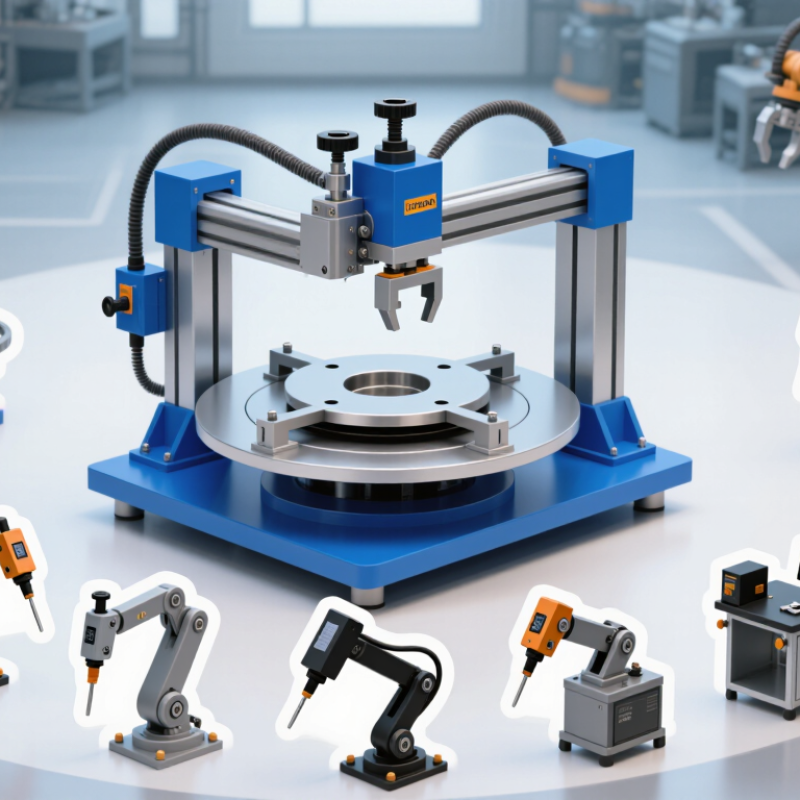
A welding positioner holds a workpiece and turns or tilts it so welders can reach the joint more consistently. A typical unit has a powered table, a drive system, and clamps or fixtures. The operator sets the angle and rotation speed, then secures the part before welding. On a small fabrication bench, that might mean rotating a pipe joint toward the welder instead of reaching underneath it. The positioner does not weld by itself. It controls the workpiece, while the welder or welding system makes the joint.
Some models rotate on one axis; others add tilt for more access. Correct setup matters: an unbalanced load can strain the drive, and loose fixtures can let the workpiece shift. The International Federation of Robotics reported 541,302 industrial robot installations worldwide in 2023, showing the scale of industrial automation, though that figure is not specific to welding positioners. The U.S. Bureau of Labor Statistics projects 2% employment growth for welders, cutters, solderers, and brazers from 2023 to 2033, with about 45,800 openings each year. These figures help explain why repeatable handling is valuable, but a positioner is not a shortcut to sound welds. Fit-up, settings, and operator judgment still matter. Some setups remain awkward, even with powered rotation. That deserves review.
Welding positioners are mainly classified by their axes of movement and the workpieces they support. A rotary-table positioner turns a part around one horizontal or vertical axis. It suits compact assemblies, such as a bracket that needs a continuous weld around its edge. Simple operation is a strength. Its limitation is reach: the operator may still need to reposition the part for angled joints.
Tilt-and-rotate positioners combine turning with table inclination, giving access to more weld angles without moving the workpiece by hand. Headstock-and-tailstock models support long parts between two ends, such as frames or shafts. They can help keep a long seam aligned, but the part’s balance and fixture design matter. Pipe turning rolls are another option for rotating cylindrical sections, though they are designed for round work rather than general assemblies.
Some positioners have fixed working heights; others allow height adjustment for different parts and operators. When comparing types, check more than rated capacity. A heavy fixture or an off-center workpiece can change the load on the table. It is easy to focus on payload and overlook reach or access. There is no perfect type for every shop, and a small mock-up can reveal awkward clearances before equipment is selected.
The chart compares common welding positioner types by their typical number of powered positioning axes. Actual configurations vary by model and application.
A welding positioner’s headline payload is only a starting point. Compare rated capacity with the combined weight of the workpiece, clamps, and fixtures. Check whether the rating changes when the load sits off-centre. A 1,000-kilogram rating may not cover a long assembly with its centre of gravity near the table edge. Record table diameter, tilt range, rotation speed, and allowable eccentric load. Ask for repeatability figures under load, not only unloaded figures.
For context, the International Federation of Robotics’ World Robotics 2024 report counted 4,281,585 operational industrial robots worldwide in 2023, a 10% rise from 2022. This measures robot stock, not welding positioner sales, but it highlights the value of checking integration details. Confirm duty cycle, motor torque, braking, control compatibility, and cable routing for the planned cell. Numbers need context. A tidy specification sheet can still omit useful details, such as speed under maximum load. Request a test record using a comparable workpiece; honestly, this step can feel slow, but it may expose a mismatch before installation.
For global buyers, a welding positioner should match the workpiece, not just the catalogue rating. Compare rated load, table diameter, tilt range, rotation speed, and control method. Then check how those figures change when a fixture and an uneven load are added. Small details matter. A compact unit may suit repeated pipe joints, while large frames need stable support and accessible controls. The International Federation of Robotics reported 541,302 industrial robot installations worldwide in 2023 in World Robotics 2024. That figure reflects wider automation activity, not positioner sales, but it signals why compatibility with robotic cells deserves attention.
A useful top-ten comparison should also consider duty cycle, service access, guarding, and spare-part availability in the buyer’s region. The American Welding Society has projected demand for 330,000 additional welding professionals in the United States by 2028. This workforce forecast makes safer, less awkward handling worth evaluating alongside throughput. Still, a high payload number can mislead if the centre of gravity is poorly controlled. Ask suppliers for load diagrams, electrical specifications, and a demonstration using a representative fixture. Test the actual weld access. I would not rank a machine on speed alone; setup time and operator visibility can decide whether it works well on a real shift.
Choosing a welding positioner starts with the workpiece, not the catalogue rating. Add the fixture weight to the part weight, then consider where the combined center of gravity sits. A long pipe may weigh less than a compact casting but place greater leverage on the table. Check the rated load at the required tilt angle, not only in the flat position. Fit-up access matters too. If a torch, operator, or robot cannot reach the joint comfortably, rotation alone will not solve the problem.
Tips: Measure the largest part and fixture together. Confirm rotation speed, tilt range, and duty cycle against your actual work. Ask for a trial with a representative load when possible. Small details count.
For repeat production, look for smooth low-speed control and reliable stopping at the weld start point. Manual controls may suit occasional jobs; programmable controls can help when parts repeat. Check floor space, lifting access, power supply, and how quickly operators can change fixtures. For international purchasing, confirm documentation language, available service support, and replacement-part lead times. These details vary by supplier and destination, so verify them directly. A positioner can look ideal on paper and still feel awkward in a real cell. Test the workflow before committing.
Compare these common positioner configurations by workpiece, motion, and application. Load ranges are indicative examples, not guaranteed ratings; actual capacity depends on the machine design, workpiece center of gravity, fixtures, rotation speed, and operating conditions.
| No. | Positioner Type | Indicative Workpiece Load | Typical Motion | Best Suited Applications | Key Selection Checks |
|---|---|---|---|---|---|
| 1 | Compact Bench Positioner | Approximately 10–100 kg | Powered table rotation; some models also tilt | Small parts, brackets, fittings, and light fabrication work | Table diameter, speed control, foot-pedal operation, and rated load at the required tilt angle |
| 2 | Manual Tilt-and-Rotate Positioner | Approximately 10–300 kg | Powered or manual rotation with manually adjusted tilt | Job shops handling varied, low-volume workpieces | Tilt-lock security, adjustment effort, work height, and access to the underside of the fixture |
| 3 | Powered Tilt-and-Rotate Positioner | Approximately 50–5,000 kg | Powered table rotation and powered tilt | Repeated circumferential and multi-angle welding | Load at the worst center-of-gravity position, tilt range, rotation speed, and control synchronization |
| 4 | Heavy-Duty Floor Turntable Positioner | Approximately 1–20 tonnes | Large horizontal-axis table rotation; tilt may be available | Large frames, structural assemblies, and heavy components | Foundation and floor loading, table diameter, braking, loading method, and clearance for the rotating assembly |
| 5 | Headstock-and-Tailstock Positioner | Approximately 0.5–50 tonnes, depending on configuration | Workpiece rotates between two supports | Long shafts, beams, vessels, and assemblies supported at both ends | Distance between supports, tailstock travel, shaft deflection, alignment, and load distribution |
| 6 | Pipe Welding Positioner | Approximately 50–2,000 kg | Controlled pipe rotation, often with adjustable supports | Pipe joints, flanges, elbows, and circumferential welds | Pipe diameter range, chuck or fixture arrangement, rotation speed, and support for long sections |
| 7 | Vertical-Axis Rotary Positioner | Approximately 0.5–50 tonnes, depending on design | Rotation around a vertical axis | Circular assemblies, large rings, tanks, and turntable-based welding cells | Radial load, table diameter, turning torque, anchoring, and the workpiece’s horizontal center of gravity |
| 8 | Three-Axis Positioner | Approximately 100 kg–10 tonnes | Table rotation, tilt, and an additional positioning axis | Complex parts needing multiple weld orientations or automated cell integration | Axis travel, collision envelope, cable routing, programmable control, and coordination with the welding system |
| 9 | Dual-Station Indexing Positioner | Approximately 20–2,000 kg per station | Indexes fixtures between loading and welding positions | Repetitive production where loading can happen while another part is being welded | Index time, station capacity, guarding, operator access, and compatibility with the welding cycle |
| 10 | Robot-Integrated Servo Positioner | Approximately 50 kg–5 tonnes per station, depending on design | Programmable rotation and/or tilt synchronized with a robot | Automated production requiring consistent torch access and repeatable positioning | Control-system compatibility, repeatability, safety interlocks, payload with fixture, and robot reach |
Selection reminder: Confirm the complete loaded mass, center of gravity, fixture mass, required rotation and tilt ranges, duty cycle, power supply, safety requirements, and installation conditions with the equipment supplier before specifying a machine.
Office: (281) 855-2218
Copyright © 2025 Telco Intercontinental Corp. All rights reserved. Privacy Policy | Legal Disclaimer
Telco®, TelcoMotion®, and TelcoGreen® are registered trademarks of Telco Intercontinental Corp.