Main Menu
Choosing a Heat Recovery Ventilator is less about chasing the highest efficiency figure and more about matching the unit to your home. The U.S. Department of Energy’s Energy Saver guidance says many heat recovery ventilators can transfer roughly 70–80% of the heat in outgoing air to incoming air. That is useful context, not a guarantee of real-world savings. A neat number can still mislead.
ASHRAE Standard 62.2 sets ventilation requirements for residential buildings, giving buyers a practical baseline for discussing airflow with a qualified installer. Building-science educator Dr. Allison Bailes has emphasized the value of treating ventilation as part of a home’s overall design, rather than as an isolated appliance. That principle matters: duct layout, climate, noise, filter access, and measured airflow can all affect performance. A quiet unit with easy-to-find replacement filters may serve a household better than a more powerful model that is poorly sized.
Small details count. Check the rated airflow, sound levels, frost-control method, controls, and warranty. Ask whether performance data follows recognized testing standards, and confirm that the unit suits your local climate. No single model is best for every house. Real homes are messy.
This guide compares leading options by efficiency, usability, installation needs, and ongoing maintenance. It also flags trade-offs, because product specifications rarely tell the whole story. Use the shortlist to narrow your choices, then verify sizing and installation requirements before buying.
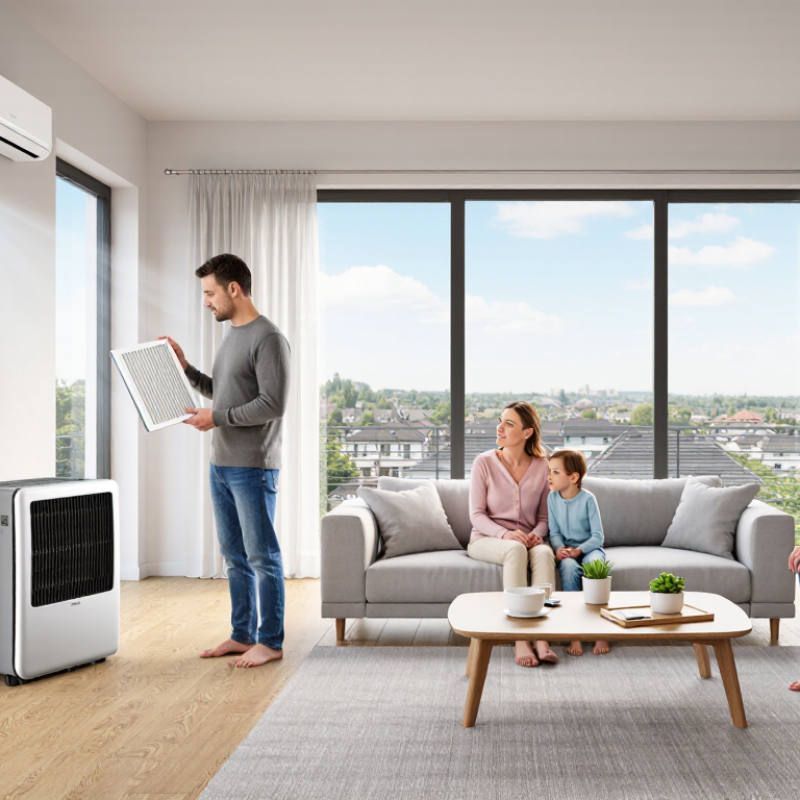
Heat recovery ventilators (HRVs) improve indoor air quality by exhausting stale air and bringing in outdoor air. During this exchange, heat from outgoing air warms incoming air in cold weather. That can help reduce odors and dilute carbon dioxide and other indoor pollutants. It is not a cure-all. Filter performance varies, and ordinary filters do not remove every gas or fine particle.
When comparing units, check whether the airflow capacity suits your home and household size. Look for accessible filters, clear maintenance guidance, and quiet operation at everyday settings. A boost mode can help clear moist air after showers, while a kitchen range hood should handle cooking fumes directly. Poor sizing or balancing can leave rooms stuffy or create uncomfortable drafts.
Installation matters. Supply vents should reach bedrooms and living areas, while stale-air pickups often belong near bathrooms or utility rooms. Ask a qualified installer to measure and balance airflow rather than relying on settings alone. Filters need regular attention, and the heat-transfer core may need periodic inspection. Dust gathers quietly. In very humid conditions, an energy recovery ventilator may be a better fit, so check local climate and building needs before buying.
Choosing an HRV starts with the home, not the largest airflow number on a product sheet. Match its rated capacity to the house size, occupancy, and ventilation plan. A qualified installer can measure supply and exhaust airflow at the grilles; balanced readings matter more than guesswork. Small differences count. Check the unit’s heat-recovery performance at conditions similar to your local winter, since test figures may not reflect every home. An HRV transfers heat, but generally does not recover indoor moisture. That distinction matters in dry climates, where indoor humidity may fall during cold weather.
Listen for sound data at the speed you will actually use, not only the lowest setting. A quiet unit can still produce distracting airflow noise through poorly designed ducts. Look for accessible filters, clear replacement intervals, and enough space to remove the core without dismantling nearby shelving. Ask how the system handles frost, because defrost cycles can affect ventilation during cold spells. Simple controls are often easier to use: boost ventilation after cooking or showering, then return to a normal setting. I would also ask for commissioning records and measured airflow values. They are useful, though readings can vary with doors, filters, and weather. No feature list replaces careful installation.
This illustrative sizing comparison uses the ASHRAE 62.2 whole-building ventilation-rate equation Q = 0.03 × floor area (ft²) + 7.5 × (bedrooms + 1), assuming three bedrooms. Choose an HRV that can deliver the required continuous airflow, then compare heat-recovery performance, sound levels, filtration, and frost protection. Verify local requirements and the applicable standard edition.
Leading heat recovery ventilators differ most in their heat-exchange cores, airflow controls, and cold-weather behavior. Counterflow cores move incoming and outgoing air through separate channels, often recovering heat efficiently without mixing the streams. Crossflow designs can be simpler, but their recovery performance may be lower. Actual results depend on airflow, installation, and maintenance—not the core alone. Small details count.
Some units use an enthalpy core that transfers moisture as well as heat. This can help keep winter air from feeling excessively dry, though it may not suit every climate or household. Ask how the core should be cleaned and whether replacement parts are readily available. A neglected filter can reduce airflow and undermine an otherwise capable system.
Defrost controls deserve close attention in cold regions. Some designs periodically reduce incoming airflow or use preheating to prevent frost buildup; each approach affects energy use and ventilation balance differently. Listen for fan noise, too. A unit that sounds quiet in a showroom may be noticeable near a bedroom wall. Compare rated airflow at realistic static pressure, not just maximum capacity, and have duct layout and balancing checked after installation. I’d be cautious about choosing from efficiency figures alone; those numbers can miss the everyday trade-offs.
What Are the Top Heat Recovery Ventilators to Buy?
How to Match an HRV to Your Home and Climate
The right heat recovery ventilator depends less on a “top” label than on your home’s layout, occupancy, and local weather. In a cold climate, an HRV can bring in outdoor air while transferring some warmth from the outgoing air. It does not create heat, so check its rated airflow and heat-recovery performance at temperatures your area actually experiences. Very cold conditions may also trigger a defrost cycle.
Size the unit for the home’s ventilation needs, not just its floor area. Bedrooms with closed doors, a busy kitchen, and a basement workshop all affect where air should move. Look for a design that can serve wet rooms, with supply air reaching living and sleeping spaces. Duct routes matter, too: long, cramped runs can reduce airflow and add noise. Quiet operation counts at 2 a.m.
Climate and habits both matter. An HRV generally transfers less moisture than an energy recovery ventilator, which may help in cold homes that need winter humidity removed. But a dry home can become uncomfortably dry. Check measured indoor humidity, local design temperatures, filter access, and frost protection before choosing. A sizing chart is only a starting point; real houses rarely behave like charts. Have an experienced ventilation professional verify airflow and installation against local requirements.
| Home or Climate Type | Best-Match HRV Setup | What to Look For | Installation and Sizing Priorities | Main Trade-Off |
|---|---|---|---|---|
| Cold, dry-winter climate | A balanced HRV with a core and defrost system designed for low outdoor temperatures. | Published sensible heat recovery performance, documented low-temperature operating limits, accessible filters, and a clear frost-control strategy. | Size the airflow for the home and local ventilation requirements. Plan insulated outdoor-air ducts, condensate drainage where required, and correctly located exterior hoods. | An HRV transfers heat but is not designed to retain indoor moisture; indoor air may become dry during winter. |
| Cold climate with high winter humidity | An HRV selected for reliable frost management and the home's moisture-removal needs. | Defrost operation that maintains safe ventilation, service access, and controls that can be balanced and commissioned. | Assess sources of excess moisture, such as cooking, showers, and indoor clothes drying. Confirm the unit can deliver the required outdoor airflow during defrost cycles. | Frost protection can temporarily affect ventilation airflow or energy use, depending on the equipment and control method. |
| Mixed or moderate climate | A standard residential HRV when winter heat recovery and moisture exhaust are priorities. | Efficiency figures reported under a recognized test method, multiple fan speeds, balanced airflow, and readily available replacement filters. | Compare the design airflow with the home's ventilation calculation, not just the unit's maximum airflow rating. Allow for duct resistance and external static pressure. | In humid cooling seasons, an HRV does not transfer moisture in the same way as an energy recovery ventilator (ERV). |
| Humid, hot climate | Compare an HRV with an ERV before buying; an ERV may be a better fit where limiting outdoor moisture entry is important. | Consider latent as well as sensible performance, cooling-system capacity, humidity control, and the ventilation system's operating schedule. | Have a qualified designer assess local humidity, air-conditioning operation, and ventilation requirements. Avoid assuming an HRV will dehumidify incoming air. | An HRV transfers heat but generally does not transfer moisture; separate cooling or dehumidification may be needed. |
| Small, airtight home | A compact, low-airflow unit that can run continuously at the calculated ventilation rate. | Quiet operation at the intended setting, low-speed control, accessible maintenance points, and documented airflow at realistic duct resistance. | Use a room-by-room ventilation plan where needed. Keep supply air away from exhaust grilles and ensure bedrooms and closed rooms receive adequate air circulation. | Noise and poor air distribution can result if a unit is oversized, poorly ducted, or operated at an unnecessarily high setting. |
| Larger home or whole-house retrofit | A central HRV with duct connections and controls suited to the home's existing heating and ventilation layout. | Suitable airflow across the expected pressure range, balancing dampers, serviceable filters, and controls compatible with the planned system. | Check whether dedicated ducts or connection to existing ductwork is appropriate. A professional should measure and balance supply and exhaust airflow after installation. | Long or restrictive ducts can reduce delivered airflow and increase fan noise and energy use. |
| Home needing quiet operation | An HRV with a suitable low-speed setting and a layout that keeps the unit and duct noise away from quiet rooms. | Look for sound data at the airflow you will actually use, vibration isolation options, and fan controls that permit adjustment. | Use appropriately sized ducts, smooth transitions, secure supports, and suitable silencers when specified by the system designer. | A published sound rating may not predict installed noise if duct design, mounting, or airflow balancing is poor. |
| Home with limited maintenance access | A model with simple, tool-light access to filters and the heat-exchange core. | Clearly identified filters, locally available replacements, a washable or replaceable core as specified by the manufacturer, and a condensate arrangement that can be inspected. | Leave adequate clearance for filter and core removal. Follow the unit's instructions for filter inspection, cleaning, and seasonal checks. | Dirty filters and blocked cores can reduce airflow and system performance, regardless of the unit's rated efficiency. |
Buying and sizing note: There is no single best HRV for every home. Select equipment based on the required ventilation airflow, climate, duct resistance, noise goals, frost control, and maintenance access. Confirm local code requirements and have the installed system commissioned and airflow-balanced. Heat-recovery ratings are test-condition dependent and should be compared using the same recognized rating method.
Before buying an HRV, match its airflow to the home’s size, bedroom count, and ventilation design—not just its advertised efficiency. ASHRAE Standard 62.2 sets residential ventilation requirements, but a qualified contractor should calculate the actual airflow for your layout. Natural Resources Canada’s Keeping the Heat In guide reports that HRVs can recover up to about 80% of heat from outgoing air; real performance varies with conditions and installation. Check independently certified ratings, including airflow, heat-recovery efficiency, and sound. Check the ducts. Undersized or leaky ducts can undermine a capable unit.
Look at where the unit will sit, how filters can be reached, and where condensate will drain. In cold climates, ask how its frost-control cycle affects fresh-air delivery. Confirm that outdoor intake and exhaust openings are separated and clear of snow, dryer vents, and vehicle exhaust. The installer should measure and balance supply and exhaust airflow after setup; otherwise, rooms may feel drafty or pressure may shift. A small admission: efficiency figures can distract from service access. A filter trapped behind stored boxes will probably be neglected. Ask for the commissioning readings in writing, then check whether replacement filters are readily available.
Office: (281) 855-2218
Copyright © 2025 Telco Intercontinental Corp. All rights reserved. Privacy Policy | Legal Disclaimer
Telco®, TelcoMotion®, and TelcoGreen® are registered trademarks of Telco Intercontinental Corp.