China Top Granulation Machine Manufacturers and Suppliers?
China has become a major manufacturing base for pharmaceutical, chemical, food, and fertilizer processing equipment. Its granulation suppliers serve both domestic factories and international production lines. A Granulation Machine can convert powders into consistent, flowable particles. That process affects tablet weight, drying time, dust control, and final product stability.
Industry reports support this growing demand. Grand View Research identifies pharmaceutical manufacturing equipment as a market driven by process automation, strict quality controls, and expanding drug production. MarketsandMarkets’ Pharmaceutical Processing and Packaging Equipment report also highlights continuous manufacturing, improved yield, and digital monitoring as important development areas. PMMI research on pharmaceutical processing further emphasizes traceability, validation, and reliable equipment integration. These findings explain why buyers increasingly examine more than price. They compare granulator capacity, product-contact materials, cleaning design, control systems, and after-sales support.
China’s leading manufacturers commonly offer high-shear wet granulators, dry granulators, fluid-bed systems, and complete granulation lines. Stainless-steel chambers, programmable controls, and adjustable cutting speeds are practical details. They matter on a busy factory floor. However, “top supplier” is not a permanent label. Rankings can change with certification, delivery performance, export experience, and service quality. Some supplier websites provide limited technical evidence. That deserves careful review.
This guide evaluates China’s notable granulation machine manufacturers and suppliers through product capability, manufacturing experience, compliance documentation, customization, and customer support. It also considers GMP-oriented design, FAT and SAT procedures, spare-parts availability, and installation assistance. Buyers should verify every claim against drawings, test records, audits, and references. A polished brochure is not enough. Reliable selection requires evidence.
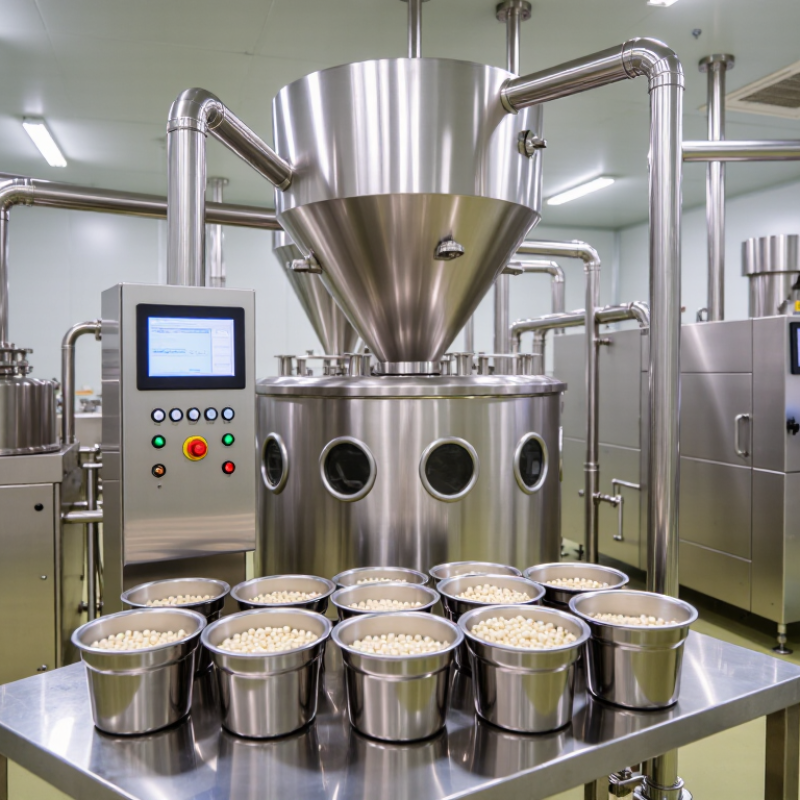
Types of Granulation Machines Used in China
China’s granulation equipment market covers several machine types, each serving a different process need.
High-shear wet granulators mix powders with a controlled binder spray, forming dense, uniform agglomerates.
Fluid-bed granulators combine spraying and drying in one chamber. They can reduce handling, but airflow must remain stable.
Dry roller compactors use pressure instead of liquid. They suit moisture-sensitive formulations and produce ribbons for later milling.
According to Grand View Research’s 2024 pharmaceutical equipment analysis, Asia-Pacific remains a major growth region, supported by expanding manufacturing capacity and stricter process controls. Mordor Intelligence’s 2024 pharmaceutical machinery report also identifies automation and continuous production as important investment directions. These reports are market estimates, not factory guarantees.
In China, rotary and oscillating granulators are often added after wet or dry processing, helping control particle size before compression or filling. The classification sounds clean. Real production is messier.
Tips:
Check powder moisture, bulk density, and heat sensitivity before selecting equipment. Ask for data from a trial batch, not only a catalog. Measure granule size distribution, yield, and cleaning time. A fluid-bed unit may shorten processing, but it can waste energy when airflow settings are poorly tuned. Roller compaction may appear simpler, yet excessive pressure can create hard ribbons and slow dissolution. Validate screen openings, spray rate, and impeller speed with trained engineers. Small errors matter.
Key Features of China’s Granulation Equipment
China’s granulation equipment is valued for practical engineering and flexible production options. Key features include adjustable granule size, stable feeding, and controlled moisture distribution. Many machines use stainless-steel contact parts, which support hygiene and easier cleaning. A clear viewing window helps operators inspect material movement during production.
Modern systems often include PLC control, variable-speed drives, temperature monitoring, and overload protection. These features improve process consistency, especially when powders behave differently between batches. High-shear granulators can handle dense blends, while fluid-bed systems support drying and coating in one workflow. However, no machine fits every formula. Testing remains essential.
Tips: Ask suppliers for material trials, particle-size data, noise levels, and energy consumption. Review cleaning procedures carefully. Check whether replacement parts are locally available and whether technicians provide practical training. Request electrical drawings, operating manuals, and documented safety tests. In real production, small details matter. A poorly sealed discharge port may create dust, while an inaccurate sensor can affect moisture control. Experienced buyers should compare complete lifecycle costs, not only the purchase price. Some specifications look impressive but may not reflect daily operating conditions.
Major Applications Across Different Industries
Granulation machines convert fine powders into controlled, free-flowing particles. In pharmaceutical production, wet granulators combine active ingredients with binders before drying. Operators monitor moisture, mixing time, and particle size closely. Small changes can affect tablet hardness and dissolution. Cleaning design also matters because residue may create cross-contamination risks. Stainless steel contact parts, sealed chambers, and documented validation support dependable operation.
Fertilizer plants use granulators to form nutrient mixtures into more uniform pellets. Better granule strength can reduce dust during conveying and bagging. In food processing, granulation helps produce instant drink powders, seasoning blends, and compressed ingredients. The process must protect flavor, color, and heat-sensitive nutrients. A temperature sensor near the discharge point gives useful production feedback.
Chemical manufacturers apply granulation to detergents, minerals, catalysts, and specialty powders. Ceramic factories may granulate powder mixtures before pressing tiles or technical components. Recycling operations can also compact selected materials for easier handling. The correct machine depends on feed moisture, throughput, particle shape, and cleaning requirements. Faster output is not always better. Excessive speed may create weak pellets or uneven density. Supplier discussions should include test batches, wear-part access, energy use, and after-sales training. One overlooked detail can become a costly production lesson.
Quality, Certification, Pricing, and Export Considerations
Choosing a granulation machine supplier in China requires more than comparing catalog prices. Quality begins with material selection, weld consistency, motor performance, and screen design. For product-contact parts, request stainless steel grades, surface-finish data, and inspection records. Ask for evidence.
Certification should match the machine’s destination and application. ISO 9001 can indicate controlled production processes, but it does not prove every machine is suitable for your product. Request certificates, calibration records, electrical test reports, and a factory acceptance test. If the equipment enters a regulated facility, check documentation for cleaning access, operator safety, and traceability. Details matter.
Pricing needs a wider calculation. Include tooling, spare screens, installation support, training, packaging, freight, insurance, taxes, and local electrical changes. A low quotation may exclude important items. Confirm capacity using real materials, not only water or sample powder. Ask for recorded tests showing throughput, granule size, moisture behavior, and operating noise. Export planning also requires correct voltage, frequency, plug standards, customs codes, and wooden-case treatment. Delivery delays can occur when documents contain inconsistent model numbers. This is easy to overlook. A reliable supplier should provide clear drawings, responsive technical communication, and an agreed inspection schedule. Still, buyers should verify every claim independently. I have seen polished brochures hide practical limitations, especially when cleaning time and changeover effort are ignored.


