What Are the Top Automated Line Types in 2026?
In 2026, choosing an Automated Line is less about buying the fastest robot and more about matching equipment to the work. A car body shop needs coordinated welding cells; a food plant may need hygienic filling, inspection, and packaging. Electronics assembly calls for precise placement and traceability, while warehouses depend on sorting and palletizing. These examples point to the line types this article will compare: robotic assembly, machining, welding, packaging, and material handling.
The scale is significant. The International Federation of Robotics reported 541,302 industrial robot installations worldwide in 2023, with 4,281,585 robots operating in factories. Its World Robotics 2024 report offers a useful baseline, though robot totals alone cannot tell buyers which line type performs best. The answer depends on product mix, changeover frequency, floor space, maintenance skills, and the cost of downtime. Small details matter: a jammed conveyor or a difficult-to-clean filler can erase expected gains.
Shigeo Shingo, a respected industrial-engineering author, warned, “The most dangerous kind of waste is the waste we do not recognize.” That lesson applies when automation makes hidden waiting, rework, or minor stoppages harder to see. The comparisons ahead will consider throughput, flexibility, labor needs, and integration—not just machine speed. No ranking fits every factory. A highly automated line can still be the wrong investment when demand shifts or operators lack support. That distinction matters.
Core Components and Operating Principles of Automated Production Lines
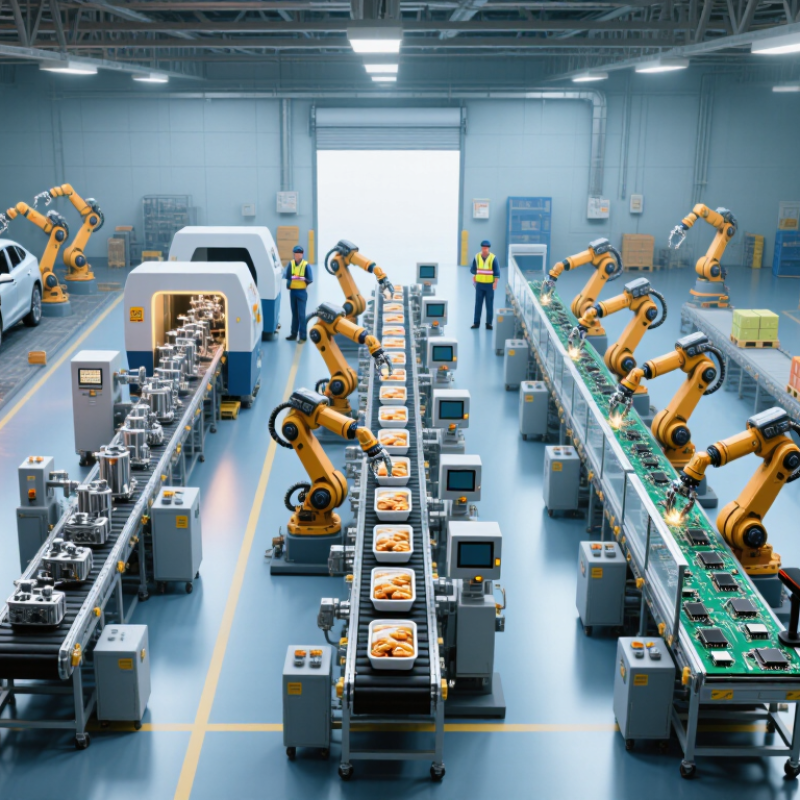
Automated production lines turn separate tasks into a coordinated flow. Their core elements usually include workstations, conveyors or robots, sensors, control hardware, and safety devices. Each element has a defined role. A conveyor moves parts between stations, while a fixture holds each part in a repeatable position. Sensors check presence, orientation, or process conditions. The controller uses these signals to permit, pause, or adjust the next operation. In an assembly line, a sensor can confirm that a component is seated before a fastening tool starts. Small details matter. A poorly placed sensor may report a part as ready when it is slightly misaligned.
The operating principle is controlled coordination, not simply faster movement. A line may run as a continuous flow, in indexed steps, or through connected cells that handle distinct tasks. Drives set motion; programmable controls manage timing and sequence; operator interfaces show alarms and production status. Operators still inspect quality, replenish materials, and respond to faults. Clear fault messages can reduce diagnosis time, though they cannot replace sound maintenance records. In practice, changeovers expose weak points: a new part may need different tooling, sensor positions, or cycle settings. The line should be tested under realistic conditions, including minor jams and incomplete inputs. Timing matters. Automation can improve consistency, but it does not make every process reliable by itself.
Automated Assembly Lines for High-Volume Manufacturing
In 2026, high-volume manufacturers often choose among pallet-conveyor lines, rotary indexing systems, and robotic transfer lines. Each suits a different product shape and production rhythm. Pallet conveyors carry fixtures between stations, supporting assemblies that need several operations. Rotary tables move compact parts through short, repeatable cycles. Fast, but specialized.
Robotic transfer lines use programmable arms for pick-and-place, fastening, or loading. They can handle product variations, though frequent changeovers still require careful setup. Sensors can check part presence, while torque monitoring helps flag inconsistent fastening. These checks improve visibility, but they cannot replace good process design. Small details matter.
The strongest line is not always the fastest one. Station balance, accessible maintenance points, and a steady supply of components all affect actual output. A single slow inspection step can hold up an otherwise rapid line. Teams should test cycle times with real parts and include planned stops in their estimates. That assumption deserves checking. Operators also need clear procedures for changeovers and recovery after a fault. A well-designed line leaves room for adjustment, because production rarely follows the perfect timing shown in a spreadsheet.
Top Automated Assembly Line Types for High-Volume Manufacturing in 2026
Indicative annual production-volume planning ranges by line type. These are broad engineering ranges, not audited industry statistics; actual output depends on product design, cycle time, operating hours, and uptime.
Dedicated transfer and rotary indexing lines are suited to repeatable, high-volume products. Synchronous conveyor, palletized, and modular robotic lines offer progressively more flexibility for varied products and production volumes.
Automated Processing Lines for Food, Chemicals, and Materials
In 2026, leading automated processing lines are designed around the material, not just the machine. Food plants often combine ingredient dosing, mixing, cooking, filling, and packaging. Sensors can track temperature and fill levels, helping teams spot variation before an entire batch is affected. A line handling sticky sauce needs different pumps and cleaning access than one processing dry grains. Small details matter.
Tips: Check changeover time, cleaning access, and sensor calibration during a real production trial. Ask operators to test routine tasks, not only ideal conditions. Automation is not a cure-all.
Chemical and materials facilities often rely on automated batching, blending, powder conveying, extrusion, or cutting. Enclosed transfer points can reduce dust escape, while interlocks and alarms help operators notice abnormal conditions. Specify materials of construction and process limits with qualified engineers; compatibility depends on temperature, concentration, and contact time. A fast line can still create bottlenecks at inspection or packing. That part is easy to underestimate. Compare expected output with actual product variability, maintenance needs, and the skills available on each shift.
Packaging and Palletizing Lines for End-to-End Fulfillment
In 2026, effective fulfillment lines connect case forming, product loading, sealing, labeling, and palletizing. A carton moves from an erector to a loading station, then past a sealer and labeler. Conveyors and sensors coordinate each handoff, while a palletizer stacks cases for shipment. This matters when product sizes change or daily volumes peak. A well-planned line can reduce repetitive lifting and keep packaging flow consistent. It still needs trained operators and clear changeover procedures.
Tips: Map package sizes, case weights, and shipping patterns before choosing equipment. Leave room for maintenance and safe access. Test real products. Not just samples. Track jams, changeover time, and damaged cases; these details show where the line needs attention.
The best setup is rarely the fastest machine alone. It balances upstream production with downstream shipping. A fast case packer can create a bottleneck if pallet exchange is slow. Mixed-SKU orders may need flexible pallet patterns and dependable recipe controls. Check that labeling data, reject handling, and backup procedures work during regular shifts, not only in demonstrations. Some layouts will need revision after operators use them. That is not failure; it is useful evidence.
Flexible Robotic Lines with AI-Enabled Quality Control
What Are the Top Automated Line Types in 2026?
Flexible robotic lines are a strong choice for factories handling frequent product changes. Robots can move parts between assembly, inspection, and packing stations. Quick-change grippers and adjustable fixtures help limit changeover time. That matters. A line designed for one product may struggle when dimensions or materials vary.
AI-enabled quality control adds another layer. Cameras inspect parts for visible defects, such as a chipped edge or a misplaced label. Software can flag unusual patterns and send questionable items to a reject bin or human review. It should not make every quality decision alone. Teams need to test the system across product variations, lighting conditions, and normal process drift. False rejects matter too; they can slow production and hide real problems in a growing queue.
A practical setup stores inspection images with production data, so engineers can trace why a part was flagged. Clear thresholds and regular checks help keep results consistent as products change. Not always. For low-volume work, the cost and effort of training vision models may outweigh the benefit. A pilot on one station can reveal missed defects, awkward handoffs, and whether operators trust the alerts before the design spreads across a whole line.


