How to Choose the Right Temperature Sensors for Your Needs
Choosing the right Temperature Sensors starts with understanding the conditions they must measure. A probe beside a hot oven faces different demands from a sensor monitoring a chilled storage room. Temperature range matters, but so do accuracy, response time, vibration, moisture, and chemical exposure. A technically accurate device can still give poor readings if it is installed in the wrong location.
Consider how the measurement will be used. Thermocouples suit many wide-range applications and respond quickly, while resistance temperature detectors often provide stable, precise readings over more limited ranges. Thermistors can detect small changes, though their operating range may be narrower. These are general tendencies, not guarantees. Check the manufacturer’s specifications, wiring requirements, calibration information, and compatibility with your controller before comparing prices.
Small details count. A long probe may create unwanted lag. A poorly sealed connection can fail in a damp process area. A sensor touching a metal wall may measure the wall instead of the material you care about. Test the installation under real operating conditions when possible, and document how readings change during startup and normal use. Keep it practical.
There is no perfect choice, and an early shortlist may need revision. That is useful feedback, not a failure. The best fit balances measurement needs, durability, maintenance effort, and total cost over time. If uncertainty remains, confirm the expected range and environment with a qualified supplier or instrumentation specialist before purchasing.
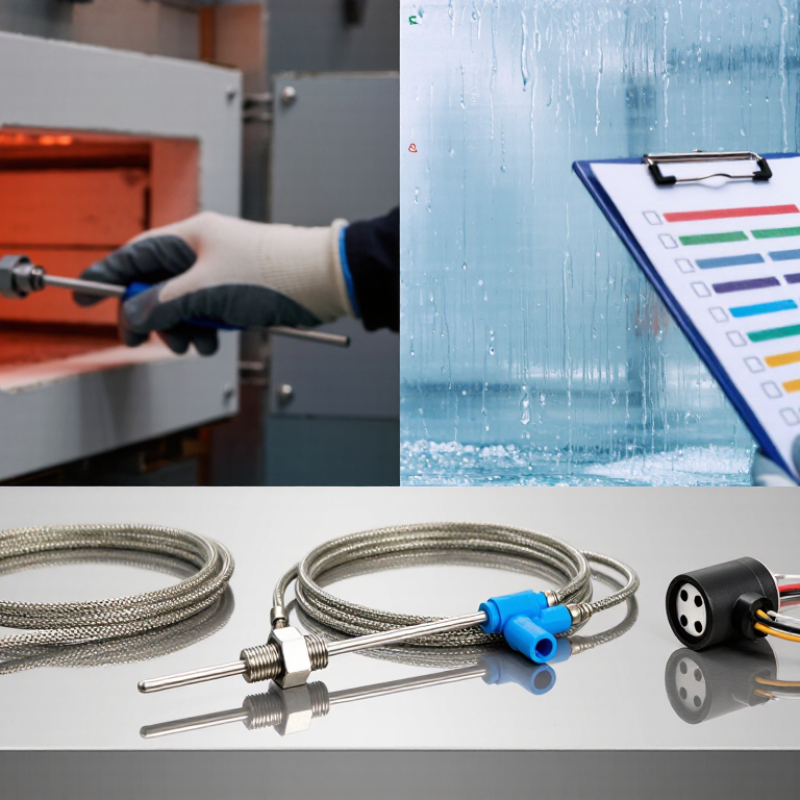
Identify the Temperature Range and Measurement Conditions
Start with the temperatures your process actually reaches, not just its normal set point. Include brief spikes, cold starts, and shutdowns; a probe may be pushed beyond its rated limits during these moments. Leave margin at both ends. Accuracy and response can change near the edges of a sensor’s range. A freezer door, for example, may expose a probe to warm, humid air every time it opens.
Then examine where and how the reading will be taken. Will the sensor touch a liquid, sit inside a pipe, or measure moving air? Metal surfaces can conduct heat away from a probe, while airflow can cool it faster than the process material. Steam, vibration, dust, and frequent washdowns may also affect the housing and installation. Small details matter. An exposed probe may react quickly but report air temperature instead of product temperature.
Check the required accuracy and response time against the real conditions, not an ideal test setup. Long cable runs and poor placement can introduce errors. Condensation or chemical exposure may shorten service life, even when the temperature is within range. These estimates are rarely tidy; a specification sheet cannot capture every installation quirk. When practical, compare a trial sensor’s readings with a trusted reference at the actual mounting point.
Evaluate Accuracy, Response Time, and Stability
Accuracy, response time, and stability determine whether a temperature reading is useful in practice. Match accuracy to the process tolerance, not just the sensor’s advertised best case. IEC 60751 specifies Class A platinum RTD tolerance as ±(0.15 + 0.002|t|)°C; at 100°C, that is ±0.35°C. This is a tolerance, not a guarantee of installed-system accuracy. Wiring, calibration, and mounting can add uncertainty.
Response time matters when temperatures change quickly. A probe inside a thick thermowell may lag behind the fluid, even if its bench test looks fast. Stability matters over months: compare calibration records for drift, and consider vibration, moisture, and repeated thermal cycling. NIST Technical Note 1297 explains how measurement uncertainty should be evaluated and reported. A tidy specification sheet cannot replace field conditions. That part is easy to overlook.
Tips: Test the complete sensor assembly in its actual mounting and flow conditions. Record response time and calibration results, then set a sensible recalibration interval. If readings drift, investigate installation before assuming the sensor itself has failed.
How to Choose the Right Temperature Sensor
Compare accuracy tolerances, response time, and stability for your operating conditions.
Accuracy at 100 °C: The chart shows maximum permissible sensor error for selected IEC tolerance classes—not guaranteed system accuracy. Probe construction, installation, wiring, and calibration also affect results. For faster response, consider a smaller or exposed sensing element; for long-term stability, consider the sensor’s operating environment and calibration needs.
Assess Installation, Environment, and Compatibility
A temperature sensor performs only as well as its installation allows. Decide whether it will measure air, a liquid, or a solid surface. For a pipe, a probe inserted into the flow usually reads more directly than one strapped outside. Check immersion depth, mounting space, and whether vibration could loosen the fitting. Small details matter.
The surrounding conditions shape the choice. Moisture, dust, corrosive fluids, and repeated heating and cooling can damage a sensor or distort its readings. Match the probe sheath and enclosure to the exposure, and confirm the operating range includes both normal conditions and likely peaks. Allow for response time, too: a thick protective sheath may be sturdy, but it can react slowly to quick temperature changes. There is a trade-off.
Compatibility deserves equal attention. Confirm that the sensor’s output, wiring, and calibration range work with the controller or display. A resistance sensor and a thermocouple do not send the same kind of signal, even if both measure temperature. Check wire length and connection requirements before ordering. A simple mistake here can produce readings that look believable but are wrong. That is easy to overlook. When conditions are uncertain, compare the equipment specifications with the actual installation, then verify readings after fitting. Real-world performance may still differ from the estimate.
Select a Sensor Based on Cost and Maintenance Needs
The purchase price is only one part of a temperature sensor’s cost. Include wiring, installation, calibration, replacement, and downtime in your estimate. A low-cost thermocouple can suit a wide temperature range, but it may need more frequent checks in demanding conditions. An RTD usually costs more upfront and can provide stable, repeatable readings. A thermistor is often inexpensive and responsive, though its useful temperature range is narrower.
Maintenance access matters. If a sensor sits inside a pipe or behind a guarded machine, routine removal can take longer than expected. Check whether the probe can be replaced without stopping the whole process. Also consider calibration intervals, available spare parts, and whether staff can verify readings with existing equipment. Small details count.
Match the sensor to the actual working environment, not just the specification sheet. Moisture, vibration, and repeated thermal cycling can affect service life. For example, a sensor near a frequently washed production line may need a durable protective sheath, adding to the initial cost but reducing replacements. It is easy to overvalue a precise reading and overlook upkeep. That trade-off deserves a second look.


