How to Choose the Best Tactical Watch for Your Needs?
How to choose the best tactical watch for your needs? The answer depends less on a rugged look and more on how you actually use a watch. A Tactical Watch may accompany you on a wet trail, a night shift, or a long day outdoors. In each setting, small details matter: readable numerals in dim light, buttons that work with gloves, and a strap that dries without rubbing. Looks are not enough.
Start with your routine, then compare features you can verify. Check the manufacturer’s water-resistance guidance, case materials, battery or charging needs, and display clarity in bright sun. If you rely on a compass, altimeter, or GPS, learn what each function can and cannot measure. Sensors may need calibration, and electronic features can drain power quickly. Simple can be better. Try the watch on your wrist, if possible; a heavy case may feel fine in a shop but tiring after several hours. I have found that the most impressive specification is not always the most useful one. That is worth questioning.
This guide will help you weigh durability, comfort, accuracy, power, and price against your actual needs. Before buying, consider replacement straps, charging access, and whether the controls feel intuitive when your hands are cold or wet. It will also explain trade-offs rather than promise one watch suits everyone. Manuals and manufacturer specifications are useful starting points, but comfort is personal. Choose carefully. The best option is one you can read, operate, and maintain when conditions become inconvenient—not simply the one with the longest feature list.
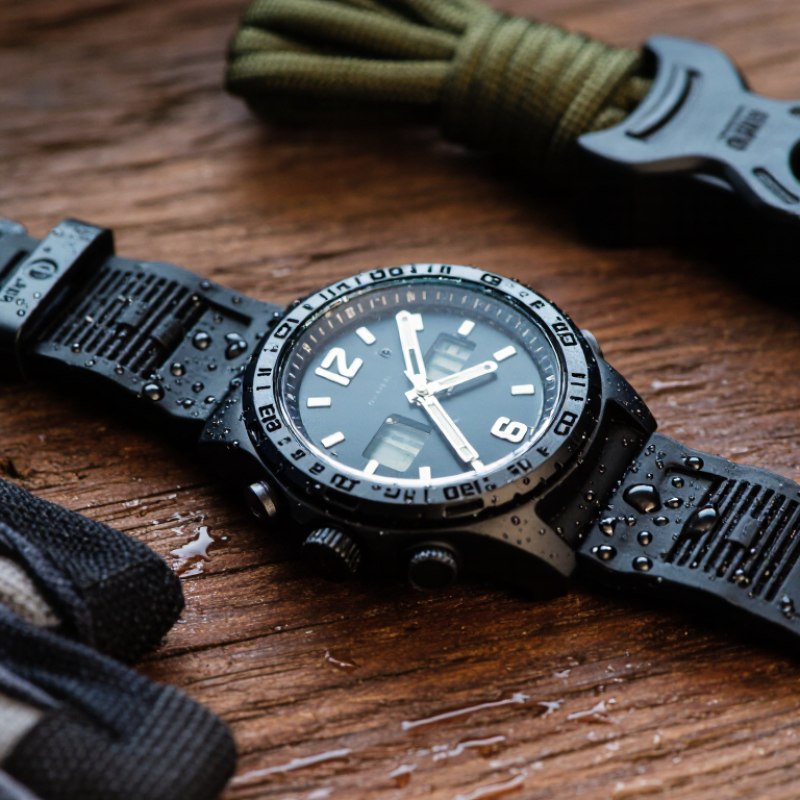
Define your mission needs: navigation, timing, visibility, and durability
Before choosing a tactical watch, picture the conditions you actually face. A trail map, a night shift, and a wet worksite demand different features. For navigation, consider a clear compass, readable direction markings, and dependable timekeeping. A compass is useful, but it still needs calibration and practice. Test it outdoors, away from vehicles and metal structures.
Timing matters when you need to track intervals, coordinate a team, or keep a schedule. Look for controls you can operate with gloves, and check whether the display stays readable while moving. Visibility is not always about brightness. Large numerals and strong contrast can help in daylight, while adjustable backlighting is useful after dark. Too much light can also attract attention or spoil night vision. A small trade-off.
Durability should match your environment, not just a specification sheet. Think about rain, dust, knocks against equipment, and temperature changes. Check the case, strap, water-resistance rating, and battery or charging requirements. If possible, try the watch with your usual gloves and clothing; a bulky case may catch on a jacket cuff. I once assumed more features meant a better tool. That was not quite right. A simpler watch you can read quickly may serve you better than one with menus you rarely use.
Check water resistance against ISO 6425’s 100 m diver-watch baseline
When choosing a tactical watch, treat ISO 6425’s 100 m diver-watch baseline as a useful benchmark, not a universal requirement. The standard covers more than a depth number: qualifying diver watches must meet defined tests for water resistance and practical underwater use. A watch marked “100 m” is not automatically ISO 6425 compliant. Check the product documentation for an explicit claim of compliance or testing.
Think about how water may reach your watch. A wet sleeve during a downpour is different from repeated immersion, and a loose crown can compromise a seal. Gaskets also age, especially after knocks or frequent temperature changes. Numbers matter. If you expect swimming or diving, look for a properly tested diver watch and have its seals checked as recommended by the maker. For ordinary field use, a lower rating may be enough, but verify what the rating actually means. It is tempting to read 100 m as “safe at any depth”; I would not. Water resistance can change over time, and a rating does not replace careful use or maintenance.
Assess durability claims by specific MIL-STD-810H test methods
How to Choose the Best Tactical Watch for Your Needs?
A rugged label tells you little unless the maker identifies the MIL-STD-810H test methods used. The standard is not a universal watch certification; test plans are tailored to a product’s expected environment. Ask for the method, procedure, severity, duration, and whether the watch remained operational during testing.
Method 516.8 covers shock, while Method 514.8 covers vibration. These test different stresses. A drop test alone does not show how a watch handles repeated vibration from tools or transport.
Temperature claims deserve the same scrutiny. Methods 501.7 and 502.7 address high- and low-temperature exposure, but the temperature range and exposure time matter. Check whether the test used a complete watch, including its strap, and whether readings stayed accurate afterward.
A test report is more useful than a bare claim, though it can still be hard to interpret. Not proof. Treat results as evidence, not a guarantee of field performance.
Think about your own use: cold mornings, dusty work areas, or frequent knocks against a metal surface. The chosen tests should match those conditions, and some uncertainty will remain.
Compare display legibility, night visibility, and gloved-hand controls
A tactical watch is useful only when its information is quick to read. Check the display in bright daylight, at an angle, and while moving. Large, high-contrast numerals usually beat decorative markings. A crowded dial can look impressive indoors, then become slow to read outdoors. Small labels may be the first details you lose under stress or fatigue.
Tips: Try the controls with the gloves you actually wear. Can you press each button without shifting your grip? Look for raised buttons with clear spacing. Test the display in a dim room, then outside after your eyes adjust. A bright light can help briefly, but it may spoil your night vision.
Night visibility varies. Illuminated hands, readable markings, and an even backlight can make checks easier, but no display suits every setting. Confirm that illumination is simple to activate and does not require several tiny button presses. If possible, test it before buying; product descriptions cannot show how clearly the digits appear to your eyes. This is not a perfect test, but it reveals awkward controls quickly. Also check whether the watch remains readable when your sleeve partly covers it. A few seconds saved matters; comfort matters too.
Match GPS and battery runtime to manufacturer-rated operating modes
A tactical watch’s battery estimate only makes sense beside its operating mode. Check the manufacturer’s rated runtime for continuous GPS, reduced-frequency tracking, and everyday smartwatch use. These figures describe different workloads, not competing promises. Short sentence. If a route requires frequent position updates, compare watches using that setting rather than a low-power mode. A long advertised runtime may rely on sparse tracking that misses turns or bends. Note whether the rating includes heart-rate monitoring, navigation, or a bright display; each can change power use.
Picture a cold, overcast day with a map open and gloves on. The screen may stay lit longer while you check a trail junction, and cold conditions can reduce usable battery capacity. Treat published runtimes as test results, not guarantees. For a planned outing, estimate the hours in your actual GPS mode, then leave a practical reserve for delays and rerouting. I would not choose from one headline number alone; it is easy to overlook the mode that matters. Check the manual’s definitions, since terms like “GPS mode” can differ between models. A small notebook test on a familiar walk can reveal whether your settings fit your routine, though one outing is hardly definitive.


