+1 (281) 855-2218

How to Choose the Best Bath Exhaust Fan?

A bathroom may look spotless while moisture lingers on the mirror, ceiling, and grout. That damp air can encourage musty odors and gradual surface damage. A well-chosen Bath Exhaust Fan helps move humid air outdoors, but choosing one involves more than picking the quietest model on the shelf.

Room size is a useful starting point. Check the fan’s airflow rating, usually listed in cubic feet per minute, and compare it with the manufacturer’s guidance for your bathroom. Then consider noise, measured in sones, and whether the duct can take a short, direct route to an appropriate exterior outlet. A powerful fan may still perform poorly if its duct is undersized, crushed, or poorly connected. Small details matter.

Controls deserve attention, too. A timer can keep the fan running after a shower, while a humidity sensor may respond automatically as moisture rises. These features add convenience, though they do not replace proper sizing or installation. Not always. The best option depends on the room, household habits, existing wiring, and budget.

This guide explains how to compare airflow, noise, energy use, controls, and installation needs. It also covers practical checks that are easy to overlook, such as cleaning access and duct condition. Manufacturer instructions and local building requirements should guide installation; when wiring or vent routing is uncertain, ask a qualified professional. A fan is not a cure-all, either. Persistent dampness may point to leaks or ventilation problems elsewhere, so the room deserves a careful look before you buy.
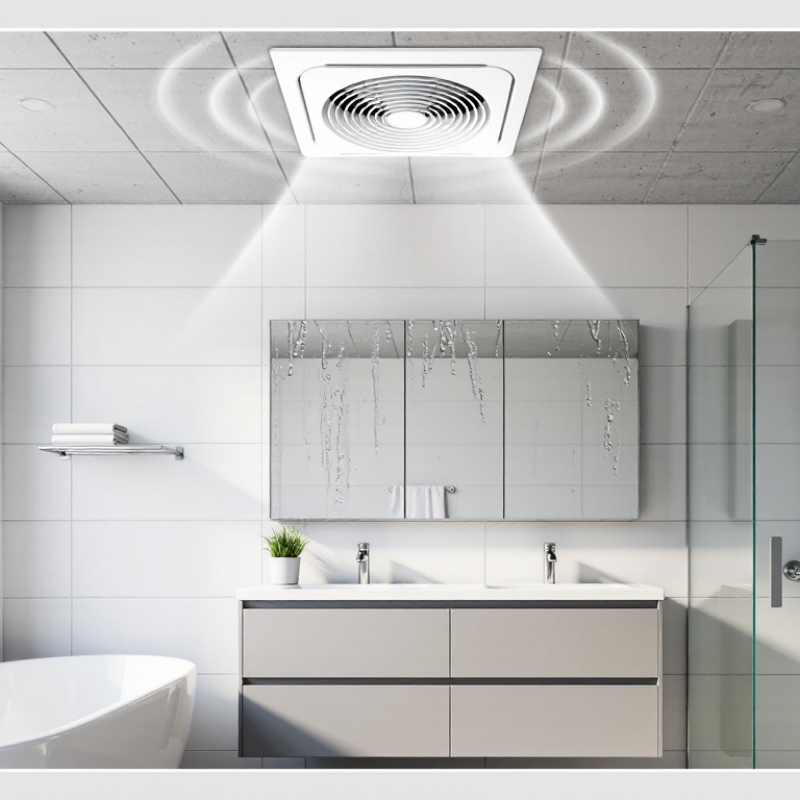
How to Choose the Best Bath Exhaust Fan?

Assess Your Bathroom’s Ventilation Needs

How to Choose the Best Bath Exhaust Fan?

Assess Your Bathroom’s Ventilation Needs

Start with the room’s floor area and how often the bathroom is used. Home Ventilating Institute guidance recommends at least 1 cubic foot per minute (CFM) of airflow per square foot for bathrooms up to 100 square feet, with a 50 CFM minimum. ASHRAE Standard 62.2 also specifies 50 CFM for intermittent bathroom exhaust, or 20 CFM for continuous operation. These figures are useful starting points, not guarantees for every layout.

Room size is only part of the calculation. A long duct run, several bends, or a restrictive exterior vent can reduce delivered airflow. A fan rated for 80 CFM may not move that amount once installed. Check the fan’s tested airflow and sound ratings, and consider whether the door has enough clearance for replacement air. Steam hanging on the mirror after a shower is a practical warning sign. Still, humidity and ventilation habits vary, so one observation cannot diagnose everything.

Tips: Measure the room, note the duct route, and check the exterior vent for blockage. Choose a fan suited to the calculated airflow, then run it during bathing and afterward. A timer can help, but settings may need adjustment after observing how quickly the mirror clears.

Calculate the Required Airflow Capacity

To estimate airflow, measure the bathroom’s length, width, and ceiling height. Multiply them to find its volume in cubic feet. Then multiply that figure by the desired air changes per hour and divide by 60. For many standard bathrooms, eight air changes per hour is a useful planning estimate, though conditions vary. Measure the room.

An 8-by-10-foot bathroom with an 8-foot ceiling holds 640 cubic feet. At eight air changes per hour, it needs about 85 cubic feet per minute (CFM). That number is a starting point, not a promise of real-world performance. Long ducts, several bends, or a restrictive grille can reduce airflow. Check the fan’s performance data at the expected duct resistance, rather than relying only on its highest listed rating. For larger rooms, or bathrooms with a separate enclosed shower or toilet area, consider whether the main calculation captures the moisture load. It may not. I would rather allow a modest capacity margin than assume every installation moves air perfectly. Keep the duct route as short and smooth as practical, and verify airflow after installation if possible.

How to Choose the Best Bath Exhaust Fan? — Calculate the Required Airflow Capacity

For bathrooms up to 100 square feet, a common sizing guideline is 1 CFM (cubic foot per minute) per square foot, with a minimum of 50 CFM. For larger bathrooms, size the fan based on the fixtures and applicable ventilation guidance. Duct length, bends, and resistance can affect actual airflow.

Compare Noise Levels and Energy Efficiency

A bath exhaust fan should remove damp air without overpowering a quiet morning. Compare sound ratings in sones: lower numbers generally mean quieter operation. A fan rated near 1 sone may fade into the background, while a louder unit can interrupt conversation. Check airflow too, measured in cubic feet per minute (CFM). The right amount depends on room size and use, not noise alone.

Tips: Compare airflow per watt, not wattage by itself. A fan that moves more air using less power can be more efficient. Look for a humidity sensor or timer if the fan is often left running; these controls can limit unnecessary operation.

Specifications help, but they do not tell the whole story. Duct length, bends, and a loose grille can increase noise or reduce airflow. A quiet model may disappoint if installed poorly. I would compare the fan’s sone rating and energy use under similar airflow conditions, then check that the duct route suits the bathroom. There is a trade-off: choosing the lowest sound rating may cost more, and a sensor may run longer than expected in a humid room. Real use can be messier than the chart.

Check Ductwork, Controls, and Installation Requirements

How to Choose the Best Bath Exhaust Fan?

Check Ductwork, Controls, and Installation Requirements

Start with the duct, not the fan’s box rating. A long, narrow run or several sharp bends can restrict airflow. Measure the duct diameter, note each turn, and check where it exits outdoors. HVI recommends about 1 CFM of exhaust per square foot for bathrooms up to 100 square feet, with a 50 CFM minimum for smaller rooms. ASHRAE Standard 62.2 lists 50 CFM for intermittent bathroom exhaust, or 20 CFM for continuous operation. These are useful baselines, not a substitute for checking the fan’s rated performance against your actual duct layout.

Controls should suit the room and household. A timer can keep the fan running after a shower; a humidity sensor can respond when moisture rises. Neither control compensates for a blocked duct or a poorly sealed exterior termination. Check the installation instructions for duct size, mounting clearance, damper direction, and electrical requirements. In cold or unconditioned spaces, insulated ductwork can help limit condensation. Small details matter.

Tips: Before buying, trace the duct to its outdoor cap and look for crushed sections or lint buildup. Compare the required opening and wiring with the existing setup. If access is tight or wiring needs changes, have a qualified installer assess the job. One easy-to-miss issue: the quietest fan may still disappoint if the duct is undersized.

Select Features That Fit Your Budget and Safety Needs

Choose a bath exhaust fan by balancing airflow, noise, controls, and installation cost—not by price alone. The Home Ventilating Institute (HVI) recommends about 1 cubic foot per minute (CFM) per square foot for bathrooms up to 100 square feet, with a 50-CFM minimum. For larger rooms, HVI suggests adding 50 CFM for each toilet, shower, or bathtub, and 100 CFM for a jetted tub. That is a useful starting point. Long ducts and extra bends can reduce airflow, though, so a low-cost fan may not clear mirror fog or damp grout effectively.

Check certified airflow and sound ratings, then compare energy use and controls. The U.S. EPA’s ENERGY STAR guidance reports that certified bathroom fans can use up to 70% less energy than conventional models. Savings matter most when a fan runs after each shower. A timer or humidity sensor can help, but adds cost and may need adjustment. For safety, confirm the fan is rated for its installation location, follow its instructions, and use a qualified professional for electrical work. Quiet is not the same as powerful. Budget for ducting, too. A fan venting into an attic still leaves moisture where it can cause problems; air needs a proper outdoor exit.

How to Choose the Best Bath Exhaust Fan? - Select Features That Fit Your Budget and Safety Needs

Compare typical fan features, costs, and safety considerations to find an option that suits your bathroom and installation.

Feature Essential Option Mid-Range Option Feature-Rich Option What to Check
Typical fan-only price About $30–$80 About $80–$180 About $180–$400+ Prices vary by airflow, controls, lighting, and retailer. Installation and ductwork are usually additional.
Airflow capacity Commonly 50–80 CFM Commonly 80–110 CFM Commonly 80–150 CFM; some models offer selectable settings For bathrooms up to 100 sq. ft., a common starting guideline is 1 CFM per sq. ft., with at least 50 CFM. Larger or unusually configured rooms may need a separate calculation.
Sound level Often around 2.0–4.0 sones Often around 0.5–2.0 sones Some models are rated around 0.3–1.0 sones Lower sone ratings mean quieter operation. Compare published sound ratings at the airflow setting you plan to use.
Controls Wall switch; fan runs when switched on Timer or humidity-sensing control may be included May include humidity sensing, a timer, or adjustable fan settings A timer or humidity control can help the fan run long enough to remove moisture without relying on memory.
Lighting and extras Fan only or basic light May include an LED light or night-light May combine LED lighting, night-light, and multiple controls Check whether the light is integrated or replaceable, and whether the fan and light can be controlled separately.
Energy use Varies by motor and airflow Compare the listed watts at the required airflow Some efficient models use electronically commutated (ECM) motors Compare watts at similar airflow levels; a lower wattage alone does not show whether the fan moves enough air.
Duct and installation fit May use a 3- or 4-inch duct, depending on model Often offers more duct or housing options May include selectable airflow or retrofit-friendly features Match the fan outlet to the duct size and route exhaust outdoors, not into an attic or enclosed space. Long or restrictive duct runs can reduce airflow.
Electrical and moisture safety Use a properly certified model and follow its instructions Check location ratings and wiring requirements Confirm every included feature is suitable for the installation location Look for an applicable safety listing, such as UL or ETL. For installation over a shower or tub, use a model specifically approved for that location and follow local electrical codes and manufacturer instructions.
Best fit Small bathroom, limited budget, straightforward installation Regular household use where quieter operation or automatic control is useful Frequent use, preference for added controls, or a need for selectable settings Choose based on room size, duct conditions, noise preference, and the features you will actually use—not price alone.

Note: Specifications and prices are typical examples, not guarantees; actual products differ. Confirm the fan’s airflow rating, sound rating, installation requirements, and local code requirements before purchasing.

SHOP BY BRAND