Who Are the Best Square Light Manufacturers in China?
Choosing a dependable Square Light manufacturer in China takes more than comparing product photos and unit prices. Buyers need to understand how each supplier handles design, production, quality checks, and communication. A neat catalog is only a starting point. The details matter: aluminum housing thickness, diffuser finish, driver specifications, and how evenly the light spreads across a room. These features can affect installation, appearance, and long-term performance.
This guide examines manufacturers through practical criteria, including product range, customization options, factory capabilities, sample quality, lead times, and after-sales support. It also highlights useful questions to ask before requesting a quotation, such as whether the supplier can provide test reports or explain its inspection process. Claims should be checked against samples and clear documentation, rather than accepted at face value. That distinction matters. A supplier may offer attractive pricing yet struggle with consistent finishes or timely updates. Even a careful comparison has limits: online information cannot fully replace a factory visit or independent product testing. No supplier fits everyone. Project scale, installation conditions, and budget all shape the right choice. The aim here is not to declare one universal winner, but to help buyers identify credible options and assess them with greater care. Small details deserve attention. A square panel that looks identical in a photograph may perform differently once installed. These recommendations are a starting point, not a substitute for project-specific checks.
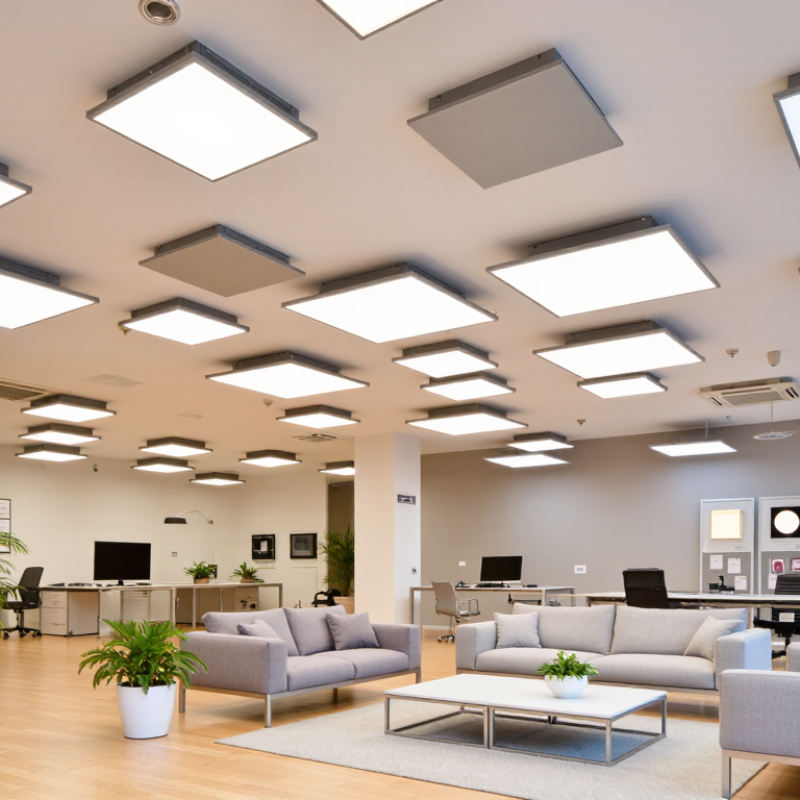
What Defines a Square LED Light? Common 600 × 600 mm Panel Formats
A square LED light is a luminaire with a square face, designed to spread light across a defined area. In offices and classrooms, the common 600 × 600 mm panel fits many suspended ceiling grids. The measurement is usually nominal. Actual frame dimensions can vary, so check the product drawing before ordering. Measure twice.
A panel typically combines an LED array, diffuser, housing, and driver. The diffuser softens visible points of light; the driver regulates power. Ask manufacturers for verified lumen output, color temperature, color rendering index, and flicker information. These details matter more than a bright-looking sample photographed in a showroom. Not quite the whole story.
For a fair comparison, confirm ceiling compatibility, installation method, warranty terms, and test documentation. A slim panel may suit a shallow ceiling, while a recessed model needs enough clearance above the grid. Driver access can also affect maintenance. Specifications are useful, but they do not always show how evenly a room will feel lit. I would want a sample tested in the actual ceiling before choosing; that extra step can seem fussy, yet it may reveal glare or uneven brightness early.
Square LED Panel Formats: Common Side Lengths
Square LED panels are commonly described by their nominal width and height. The 600 × 600 mm format is a widely used reference size; actual panel dimensions can vary to suit ceiling-grid systems.
The chart compares example format dimensions, not manufacturer performance or product rankings. For fit, check the fixture’s actual dimensions and the ceiling system’s specifications.
Which Safety Standards Apply? IEC 60598-1 and China’s GB 7000.1
For square luminaires, shape does not reduce safety obligations. IEC 60598-1 sets general requirements for construction, electrical protection, temperature, insulation, and testing. In China, GB 7000.1-2023 provides the corresponding general safety requirements for luminaires. Buyers should confirm which edition and market requirements apply to the product and sales destination. The IEA’s Energy Efficiency 2023 report estimates that buildings account for about 30% of global final energy use, making dependable lighting a practical concern as well as a safety issue.
A square panel should be checked in its actual configuration: driver, wiring, enclosure, mounting method, and thermal management can all affect test results. Ask for reports that identify the precise model and tested sample, not just a general certificate or a similar-looking product. Check markings and instructions, too. Small details matter. A thin metal edge, loose terminal, or crowded driver compartment may expose weaknesses that photographs cannot show. IEC and GB requirements are closely related, but evidence against one standard should not automatically be treated as proof of compliance with the other. I would also ask how design changes are controlled after testing; this step is easy to overlook, and it deserves a clear answer.
How to Compare Performance: Efficacy, CRI Ra ≥80, and UGR ≤19
When comparing square light manufacturers in China, ask for measured efficacy, not just a headline figure. Efficacy is useful only when the wattage, output, and test conditions are clear. A fixture claiming high lumens per watt may still create harsh shadows or uneven desk lighting. Check the photometric file and compare products at the same color temperature and power. Small details matter.
CRI Ra ≥80 is a practical baseline for offices, shops, and classrooms. It helps colors appear reasonably natural, though it does not guarantee accurate rendering of every red tone. Ask whether the value comes from a test report, and check the stated tolerance. UGR ≤19 indicates reduced discomfort glare under specified room conditions; it is not a fixed property of the fixture alone. Ceiling height, spacing, and surface reflectance can change the result. Numbers need context.
For a fair review, compare the same room layout and mounting height across suppliers. Request UGR tables, efficacy data, and a sample for a visual check. Look at the diffuser from seated positions, not only beneath the light. A neat datasheet is reassuring, but it cannot replace a mock-up. I may be overvaluing paperwork here; a real installation can reveal flaws the report misses.
How Manufacturers Verify Light Output: LM-79 Photometric Testing
For square lights, a claimed lumen figure is only useful when the test conditions are clear. ANSI/IES LM-79-19 defines methods for measuring solid-state lighting products’ electrical and optical performance. An independent laboratory records input power, total luminous flux, efficacy, color characteristics, and light distribution. A sphere captures total output; a goniophotometer maps where the light goes. Small differences matter: a 600 mm panel can look bright directly below yet leave desk corners dim.
A credible LM-79 report identifies the exact sample, operating position, supply conditions, and stabilization procedure. Ask to see the full report, not a cropped lumen figure. Check whether measured watts and lumens match the product specification, and whether the distribution data suit the intended ceiling height. The U.S. Department of Energy’s Energy Saver guidance says LEDs use at least 75% less energy and can last up to 25 times longer than incandescent lighting; these are broad technology benchmarks, not guarantees for any square fixture. That distinction is easy to miss. Even a clean laboratory result cannot predict glare, room reflections, or poor installation. Test reports can be persuasive, but one sample is still one sample.
How to Evaluate Chinese Manufacturers: Quality Systems, Customization, and Export Capacity
When comparing Chinese square-light manufacturers, inspect production controls, not just certificates. Ask for a current quality-system certificate and confirm its scope covers the relevant factory. Request batch records for LED modules and drivers, plus aging-test results with test duration and temperature. Check whether photometric reports identify the tested model and configuration. Small details matter.
The IEA’s Energy Efficiency 2019 report estimates that lighting accounts for about 15% of global electricity use and 5% of greenhouse-gas emissions. Treat those figures as industry context, not proof of a supplier’s performance. A polished audit file can still hide weak process control. Visit the line or commission an independent sample test when order size justifies it.
For customization, compare approved drawings, sample measurements, and written tolerances for dimensions, color temperature, and dimming. Ask how design changes are recorded; a verbal promise is easy to forget. Export readiness also needs evidence: request anonymized shipment references, packaging specifications, and the named person responsible for export documents. The World Bank’s 2023 Logistics Performance Index ranked China 19th among 139 economies, but national logistics performance cannot verify one factory’s reliability. Check the factory’s own delivery history. And inspect the carton. A good luminaire can still arrive damaged.


