Main Menu
Choosing the right Electric Forklift Battery in 2026 requires more than comparing price and voltage. Global buyers must examine duty cycles, warehouse temperatures, charging infrastructure, maintenance skills, and total operating cost. A battery that performs well in a chilled distribution center may struggle in a hot outdoor yard. Context matters.
Jeff Dahn, a leading lithium-ion battery researcher, puts it plainly: “The battery is the most important component in an electric vehicle.” His view also applies to forklifts, where battery performance affects lifting speed, shift coverage, operator safety, and business continuity. Lead-acid, lithium-ion, and newer battery technologies each offer practical advantages. Lithium-ion batteries support opportunity charging and reduce routine watering. Lead-acid batteries remain familiar and may suit operations with established charging rooms. Newer options can appear attractive, but their long-term service data deserves careful examination.
No chemistry wins everywhere. A buyer should measure actual energy use across a full shift, not rely on brochure figures. Inspectors should review battery enclosure quality, thermal management, charging controls, and emergency procedures. Certification requirements also vary by market, facility type, and equipment design. Professional suppliers should provide test records, warranty terms, recycling guidance, and transparent replacement costs.
This guide compares the best Electric Forklift Battery types for global buyers in 2026. It focuses on real warehouse conditions, not perfect laboratory scenarios. Some conclusions remain uncertain. Battery prices, raw-material supply, and charging standards may change quickly. Careful evaluation still beats fashionable choices.
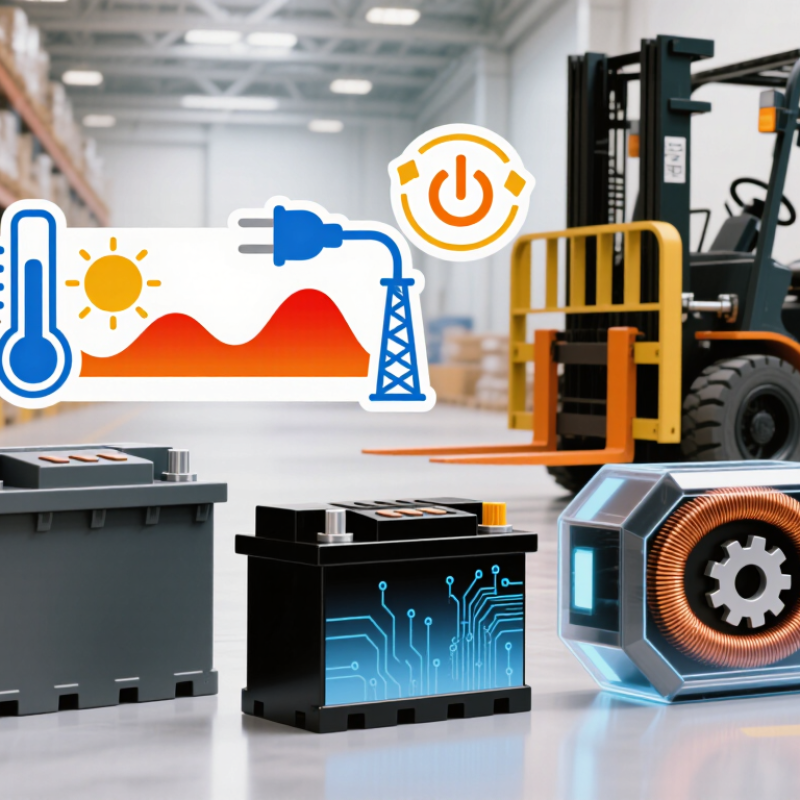
2026 Best Electric Forklift Battery Types for Global Buyers
Electric forklift battery choice depends on duty cycle, climate, charging access, and total operating cost. Lead-acid batteries remain familiar and widely serviceable. The U.S. Environmental Protection Agency reports that lead-acid batteries achieve approximately 99% recycling rates in the United States. However, they require watering, scheduled charging, and battery changes during intensive shifts. Charging areas also need suitable ventilation and trained handling procedures.
Lithium-ion batteries deliver higher usable energy and accept opportunity charging during short breaks. The U.S. Department of Energy identifies high energy density, strong charge efficiency, and reduced maintenance as major lithium-ion advantages. In practical warehouses, a forklift can often return to work after a brief charging session. Cold rooms expose flaws. Low temperatures can reduce charging performance, while poor thermal control may shorten battery life. Buyers should request tested cycle data, not only advertised capacity.
Fuel-cell forklifts offer rapid refueling and stable performance across multi-shift operations. The Department of Energy’s fuel-cell guidance commonly places low-temperature system efficiency near 40–60%, depending on design and conditions. Yet hydrogen storage, dispensers, safety training, and local infrastructure increase project complexity. Fuel cells may suit large distribution centers with predictable traffic, but they can be excessive for small sites. The imperfect part is forecasting demand: shift patterns change, and energy models often underestimate waiting time, seasonal cold, and operator behavior. Practical trials should measure charging queues, downtime, and real kWh consumption before procurement.
Lead-acid forklift batteries remain a practical choice for buyers managing cost-sensitive warehouse fleets. Their purchase price is often the lowest among common industrial battery options. For many operations, that difference can protect the initial equipment budget. The initial invoice is usually easier to approve.
Yet cycle claims are not guarantees. A rated life of 1,500–2,000 cycles assumes controlled charging, suitable temperatures, and regular maintenance. Deep discharges, excessive heat, and poor watering can reduce actual performance. Real service life can be shorter. That reality deserves attention.
In daily operations, charging discipline strongly affects battery life. Technicians should check electrolyte levels and inspect connectors for corrosion. Watering should follow the supplier’s maintenance instructions, using suitable water quality. Charging areas also need proper ventilation and safe access. This is not optional. Poor ventilation can create serious workplace hazards.
The low purchase cost can hide labor and infrastructure expenses. A fleet with spare batteries may need changing equipment, storage space, and trained staff. Lead-acid units also require downtime during charging. For two-shift operations, this limitation may affect productivity. Buyers should compare total operating costs, not purchase price alone. I would not treat the 1,500–2,000-cycle figure as a promise. The cheaper option can become expensive when maintenance is neglected. Request test data for the expected duty cycle, climate, and daily operating hours. Then inspect local service capacity before ordering.
Lithium-ion batteries are becoming a practical choice for global forklift buyers. Industry research from IDTechEx’s Electric Forklifts 2024–2034 report highlights their growing role in warehouse electrification. Many lithium-ion packs deliver approximately 2,000–4,000 charge cycles, depending on chemistry, temperature, depth of discharge, and maintenance. That range is useful, but it is not guaranteed.
Fast charging changes daily operations. A suitable lithium-ion system can often recharge in one to two hours, allowing forklifts to return during planned breaks. The U.S. Department of Energy reports that lithium-ion technology offers high energy efficiency and reduced charging losses compared with traditional lead-acid systems. Operators also avoid routine watering and battery-room ventilation. Less downtime. Still, high charging power can increase heat and grid demand. This detail is sometimes overlooked. In cold warehouses, performance may also fall unless the battery includes thermal control.
Tips: Match battery capacity with shift length, load weight, and ambient temperature. Request cycle-life test conditions, not only headline figures. Check charger compatibility before purchase. A 2,000-cycle rating at shallow discharge is not equal to the same rating under intensive use. Track charging time, battery temperature, and daily energy use for three months. Real operating data is often more valuable than a sales brochure. Regional recycling rules and service availability should also influence the buying decision.
Typical service-life cycles and full-charge time by battery type. Lithium-ion batteries generally provide 2,000–4,000 cycles and approximately 1–2 hours of fast charging.
Values are typical industry ranges and may vary according to battery chemistry, charging method, operating temperature, depth of discharge, and maintenance practices.
For global forklift buyers, LiFePO₄ batteries offer a practical balance between operating life, safety, and daily productivity. Quality cells can deliver about 3,000–5,000 cycles under suitable charging and working conditions. A cycle means total energy used and replenished, not simply one shift.
That distinction matters. A warehouse running two shifts may consume a cycle faster than expected. Heat, deep discharge, poor charging settings, and heavy loads can shorten service life. Real operating data matters more than a brochure number. Buyers should request cycle-test conditions, usable capacity, warranty terms, and battery management system records.
Thermal safety is a major advantage of LiFePO₄ chemistry. Its stable structure reduces the risk of thermal runaway when compared with less stable lithium chemistries. The battery management system can monitor temperature, voltage, and current during charging. Still, safety is not automatic. Proper ventilation, compatible chargers, secure installation, and trained operators remain essential.
Cold storage needs extra attention. Low temperatures can reduce available power and may restrict charging until the cells warm safely. In a busy loading area, this can create delays. We have also seen capacity estimates fail when buyers ignore ramp gradients and attachment weight. The better assessment uses actual routes, load weights, shift length, and local climate. Even then, projections should remain conservative.
For global buyers in 2026, battery selection should start with duty cycle, not chemistry. Lead-acid batteries remain attractive for low-use fleets and lower purchase budgets. Lithium-ion suits multi-shift operations because opportunity charging reduces battery changes and idle time. Measure every shift. Voltage must match the truck, charger, connector, and site power capacity. A 48-volt battery is not automatically better than a 24-volt unit. It must deliver stable power under the actual load.
Runtime changes with load weight, travel distance, tire condition, and operator habits. Cold storage can reduce available capacity and slow charging. Heat accelerates battery ageing, especially when ventilation is poor. Charging discipline matters. The U.S. Department of Energy recommends controlled charging practices and site planning for industrial electric equipment. The International Energy Agency reported global battery demand above 750 GWh in 2023, showing stronger supply depth, but forklift-grade cells still need careful verification.
Total cost of ownership should include energy, chargers, maintenance, replacement batteries, downtime, and trained labor. BloombergNEF’s 2024 Battery Price Survey reported an average lithium-ion pack price of 115 dollars per kWh, down 20 percent year over year. That figure does not equal a forklift’s delivered cost. Warranty terms, import duties, climate controls, and installation can change the result sharply. I would not trust a spreadsheet using only purchase price. A modestly cheaper battery may become expensive after two daily shifts, winter heating, and unexpected charging delays.
| Selection Criterion | Flooded Lead-Acid | AGM Lead-Acid | Gel Lead-Acid | Lithium Iron Phosphate (LFP / LiFePO₄) | Nickel-Manganese-Cobalt (NMC Lithium-Ion) |
|---|---|---|---|---|---|
| Common forklift voltage configurations | 24V, 36V, 48V, 72V and 80V | 24V, 36V and 48V; higher voltages are available in modular packs | 24V, 36V and 48V; higher voltages are less common | 24V, 36V, 48V, 72V and 80V; modular systems can cover other voltage classes | 24V, 36V, 48V, 72V and 80V; application-specific pack design is common |
| Typical usable depth of discharge | Approximately 70–80%; deeper discharge can significantly reduce service life | Approximately 70–80%; avoid repeated full discharge | Approximately 70–80%; sensitive to over-discharge and improper charging | Approximately 80–95%, subject to the battery-management-system limits | Approximately 80–95%, subject to the battery-management-system limits |
| Typical round-trip energy efficiency | Approximately 75–85% | Approximately 75–85% | Approximately 75–85% | Approximately 90–97% | Approximately 90–97% |
| Typical cycle life at appropriate operating conditions | Approximately 1,200–1,800 cycles | Approximately 500–1,200 cycles | Approximately 800–1,500 cycles | Approximately 3,000–7,000 cycles | Approximately 1,500–3,000 cycles |
| Runtime per charge | Usually one standard shift; a spare battery may be needed for multi-shift operation | Usually one standard shift; runtime decreases under high-current or heavy-load duty | Usually one standard shift; best suited to moderate-duty applications | Often one to two shifts depending on pack size; consistent voltage supports stable performance | Often one to two shifts; high power-to-weight ratio supports demanding duty cycles |
| Opportunity charging suitability | Limited Frequent partial charging can cause sulfation and shorten life unless the charging profile is specifically designed for it. | Limited Less electrolyte maintenance, but repeated opportunity charging is still not ideal. | Limited Requires carefully controlled charging to avoid overcharge and gas accumulation. | Excellent Designed for frequent partial charging when the BMS and charger are correctly matched. | Excellent Suitable for high-utilization fleets with properly controlled charging and thermal protection. |
| Typical recharge time | Approximately 6–10 hours, followed by a cooling period | Approximately 6–10 hours; charging speed depends on pack design and heat control | Approximately 8–12 hours; conservative charging helps protect service life | Approximately 1.5–3 hours with a compatible high-rate charger; slower charging extends battery life | Approximately 1–3 hours with a compatible high-rate charger; thermal management is important |
| Charging infrastructure requirement | Ventilated charging room, compatible charger, watering equipment and spill-control procedures | Ventilated area and compatible charger; no routine watering | Ventilated area and compatible charger; no routine watering | Dedicated lithium-ion charger, battery-management system, communication interface and suitable electrical protection | Dedicated lithium-ion charger, battery-management system, thermal monitoring and suitable electrical protection |
| Routine maintenance | Watering with approved water, cleaning, equalization charging and inspection for corrosion | Low maintenance; inspect terminals, casing and charging performance | Low maintenance; inspect terminals, casing and charging performance | Very low No watering or equalization; periodic inspection and BMS diagnostics are required. | Very low No watering or equalization; periodic inspection and BMS diagnostics are required. |
| Cold-climate performance | Capacity and charging acceptance decline at low temperatures; charging a frozen battery can cause damage | Capacity declines in cold conditions; controlled charging is required | Capacity declines in cold conditions; charging below the approved temperature range should be avoided | Good discharge performance with thermal control; charging below 0°C generally requires heating or a charge lockout | Good power performance with thermal control; low-temperature charging protection is essential |
| Hot-climate performance | High heat accelerates water loss, corrosion and plate degradation; ventilation is important | Heat can accelerate aging and reduce service life; temperature control is recommended | Heat can accelerate aging and drying; avoid prolonged exposure to high ambient temperatures | Good performance with thermal monitoring; prolonged high temperature can accelerate cell aging | Good power performance with thermal monitoring; high temperature affects life and safety margins |
| Water and dust exposure | Use a protected battery compartment; electrolyte and corrosion controls are necessary | Sealed construction reduces leakage risk, but the pack still requires suitable enclosure protection | Sealed construction reduces leakage risk, but the pack still requires suitable enclosure protection | Specify enclosure protection appropriate to the truck environment, commonly IP54 or higher for exposed applications | Specify enclosure protection appropriate to the truck environment, commonly IP54 or higher for exposed applications |
| Energy density by weight | Low; typically about 30–40 Wh/kg at cell level | Low; typically about 30–40 Wh/kg at cell level | Low; typically about 30–40 Wh/kg at cell level | Medium; typically about 90–160 Wh/kg at cell level | High; typically about 150–250 Wh/kg at cell level |
| Safety profile | Well-established technology; hydrogen generation during charging requires ventilation and ignition control | Reduced electrolyte-spill risk; charging still requires ventilation and correct temperature control | Reduced electrolyte-spill risk; incorrect charging can cause heat and pressure buildup | Strong thermal stability compared with many other lithium chemistries; BMS, fusing and certified integration remain essential | High energy density; robust cell monitoring, thermal management and certified pack protection are essential |
| Initial purchase cost | Low | Low to medium | Low to medium | Medium to high | High |
| Expected total cost of ownership | Low for single-shift, low-utilization fleets; labor, charging losses, spare batteries and replacement frequency can increase lifecycle cost | Low to medium; may be attractive where spill reduction is important but opportunity charging is not required | Low to medium; suitable for moderate duty where maintenance reduction is valued | Often low for multi-shift, high-utilization fleets because of lower maintenance, higher efficiency and reduced battery swapping | Potentially competitive for applications requiring low weight, high power or long runtime; cell replacement cost can be significant |
| Best-fit operating profile | Single-shift warehouses, outdoor yards, cost-sensitive fleets and operations with battery-changing facilities | Light-to-medium duty, cleaner indoor environments and fleets seeking reduced watering requirements | Moderate-duty indoor applications where low maintenance and sealed construction are priorities | Multi-shift warehouses, cold-chain logistics, intensive distribution and fleets using opportunity charging | Weight-sensitive equipment, high-power applications and operations requiring high energy density |
Office: (281) 855-2218
Copyright © 2025 Telco Intercontinental Corp. All rights reserved. Privacy Policy | Legal Disclaimer
Telco®, TelcoMotion®, and TelcoGreen® are registered trademarks of Telco Intercontinental Corp.